

Identification Characteristics
Perennial bunchgrass
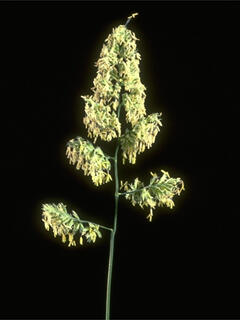
Branched, with lower branches longer in length than top ones. No awns. Stiff panicle, either compact or slightly spreading.
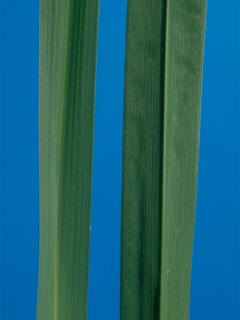
Distinctively flattened and keeled sheath. Leaf folded in the bud. Tapers to an acute point. Rough edges. Coloring is light green to dark blue-green.
Ligule is truncated, membranous, and 1/10-1/13 inch in length.
Canopy: Stands are 24-48 inches (0.61-1.22 m) tall.
Deep, extensive, and fibrous. No rhizomes or stolons.
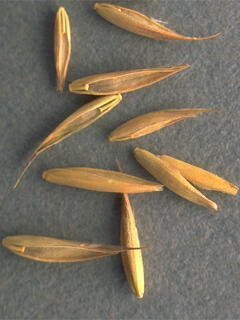
Tan in color. Keeled, with lemma pointed and twisted.
Growth Habit and Stand Life
Habit: Erect bunchgrass, graminoid
Life: Moderate length perennial
Climate and Soil Suitability Zones
Temperature: 1.4 to -23.8 °F/ -17 to -31 °C; Winter hardy
Precipitation: 13.8-21.7 inches (350-550 mm)
pH: 5.6-8.4
pH: 5.6-8.4
Soil drainage: ED-MWD
Salinity: Moderately sensitive, 1.5-3 dS/M
Drought Tolerance: Medium
Flood Tolerance: Medium. Tolerates 15-25 days of flooding.
Climate suitability characteristics in the following table are based on field experiments and forage agronomist experience. Soil factor data are based on values provided in Chapter 3 of the NRCS Range and Pasture Handbook (https://www.nrcs.usda.gov/Internet/FSE_DOCUMENTS/stelprdb1043060.pdf).
| July Max Temp (°C/F°) | Jan Min Temp (°C/F°) | Annual Precipitation (mm/in) | Soil pH | Drainage Class | Soil Salinity (dS/m) | |||||||
|---|---|---|---|---|---|---|---|---|---|---|---|---|
| Low | High | Low | High | Low | High | Low | High | Low | High | Low | High | |
| Well-suited | 22/72 | 31/88 | -12/10 | 9999 | 550/21.7 | 9999 | 5.75 | 7.5 | MWD | MWD | 0 | 2 |
| Moderately-suited | 20/68 | 33/91 | -17/1 | 9999 | 450/17.7 | 9999 | 5.25 | 7.75 | SPD | MWD | 0 | 6 |
| Marginally-suited | 18/64 | 35/95 | -22/-8 | 9999 | 350/13.8 | 9999 | 4.75 | 8.25 | PD | WD | 0 | 8 |
**For the values of Jan min temp and annual precipitation: 9999 indicates no limit to the high values.
Soil Drainage categories: VPD (very poorly drained), Pd (poorly drained), SPD (somewhat poorly drained), MWD (moderately well drained), WD (well drained), SED (somewhat excessively drained), ED (excessively drained).
Response functions were developed from these tabular values using Rstudio scripts, with parameters provided for climatic and soil GIS spatial data layers.
Suitability Maps
To create highly detailed and accurate species suitability maps it was necessary to change from a qualitative description of plant characteristics to an approach that defines tolerances quantitatively. Tolerances to climatic and soil factors were defined (Table 1) and used to map suitability based on summary publications (Moser et al., 1996) and expert knowledge of forage scientists.
Moser, L.E, D.R. Buxton, and M.D. Casler, Eds. 1996. Cool Season Forage Grasses. American Society of Agronomy Monograph 34. 841 pp. ASA, CSSA, and SSSA, Madison, WI.
Suitability patterns for forage species are caused by different factors in different locations. Low winter temperatures limit the northern range of many species, while low precipitation limits the western range of species in the semi-arid west. Low summer temperatures limit the range of species with increasing elevation while high summer temperatures limit the range in the desert southwest and hot and humid southeast. Soil characteristics (pH, drainage, and salinity) also limit the suitability zones of forage species. However, soil amendments (liming and drainage tiles) can alleviate many of these limitations. Thus, NRCS Soil Survey data should be informed and revised by management mitigations.
GIS software allow creation of highly detailed and accurate species suitability mapping based on biophysical characteristics of the region and plant characteristics (Hannaway et al., 2005). Precipitation and maximum and minimum temperature climate grids are now available for annual and monthly periods. Soil type, depth, drainage, pH, salinity, and alkalinity information was obtained from the NRCS STATSGO2 database. Species characteristics were provided by forage experts.
Hannaway, D.B., C. Daly, L. Coop, D. Chapman, and Y. Wei. 2005. GIS-based Forage Species Adaptation Mapping. pp. 319-342. In: S.G. Reynolds and J. Frame (eds). Grasslands: Developments, Opportunities and Perspectives. FAO and Science Pub. Inc., Rome, Italy.
Maps
Nine maps were developed; 1) 30-year long-term July maximum temperature 2) 30-year long-term January minimum temperature, 3) 30-year long-term annual precipitation, 4) soil pH, 5) soil drainage, 6) soil salinity, 7) combined climate factors, 8) combined soil factors, and 9) combined climate and soil factors.
The Contiguous USA
|
Climate Factors |
Soil Factors | All Factors Combined |
|---|---|---|
|
Minimum Temperature Image

|
pH Image

|
Climate and Soil Image

|
|
Maximum Temperature Image

|
Drainage Image

|
All Soil Image

|
|
Precipitation Image

|
Salinity Image

|
All Climate Image

|
Click on the thumbnail image to view a larger map.
Yield Potential and Production Profile
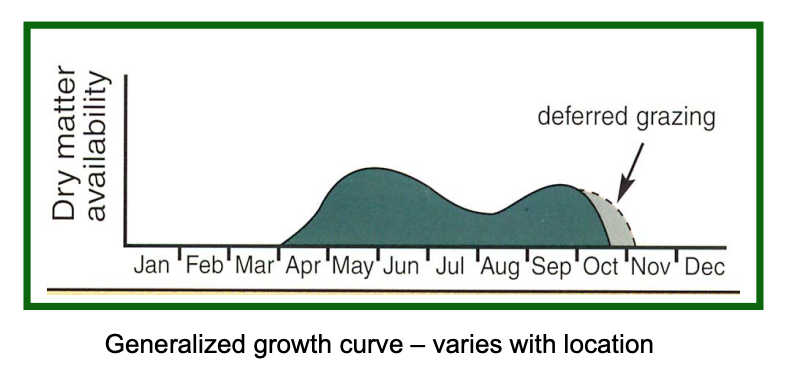
High fruit/seed abundance. Grows best in cool conditions (54 to 73°F), moderate to well-drained soils, non-saline conditions (1.5-3 dS/M), and acidic to alkaline soils (pH 5.2-7.0). Optimum production is achieved in areas with little spring frost. Forage yields can reach 7,000 to 10,000 lb/acre under ideal conditions and with proper management and a 120-130 day growing season.
Cultivars
‘Latar’ has lower fiber content and 10% higher digestibility; matures 10-14 days later than common orchardgrass, making it highly suitable for high quality hay when mixed with alfalfa. Forage yield is equivalent to common orchardgrass in terms of per acre, and quality is superior.
‘Potomac’ is a productive, rust-resistant, persistent cultivar. Matures early, making it unsuitable for use in alfalfa-hay mixes. Use in circumstances where early maturity is desired.
‘Paiute’ produces many basal leaves and leafy upright stems, making it an ideal forage cultivar. Excellent for use on arid rangelands as a forage.
Several other cultivar types are available, including ‘Akaroa,’ ‘Berber,’ ‘Pomar,’ and ‘Sandia
Establishment and Management
Provide firm, weed-free seedbed. Seed during early to mid-spring for irrigated settings, and late fall or early spring for a dryland setting. Do not seed after the spring moist season has advanced as failure may occur due to drought or hot summer temperatures. Common agricultural drills work well, and deep furrow or double disc drills with press wheels are suitable for seeding as well. Seed at a depth of ¼ to ½ inch (0.635-1.27 cm) with 4 lbs/a (4.48 kg/ha) of pure live seed. Adjust seeding amount as needed within mixed plantings.
Fertilization: Very responsive to nitrogen application. Fertilize stands after the first or second cutting or grazing for a production boost in late spring and summer. Apply fertilizer when needed, informed by regular soil tests. 120 to 140 lb N/a (135-157 kg N/ha) annually is suggested for established stands.
Harvesting: Do not graze until late summer or early fall of the first or second growing season for irrigated and dryland conditions respectively. Use less than 60% of annual growth during winter or 50% of growth during growing season for optimal results. Close grazing in fall is associated with winterkill. Allow periods of maturation and seed production to occur for stand continuation.
Management Level Required
Quality and Antiquality Factors
Properly fertilized, well-managed stands of orchardgrass are capable of producing high-quality forage, with high levels of palatability, digestible energy, protein, and minerals. Orchardgrass accumulates high levels of usable carbohydrate in spring and fall. Composition, however, depends largely on maturity stage at harvest and on fertility. For hay or silage at early boot stage (prior to head emergence).
In summary, orchardgrass is:
- highly palatable to all livestock classes,
- has high yield potential, and is
- wildlife friendly.
Due to its rapid growth rate, orchardgrass may become invasive. It does not tolerate saturated soil for extended periods and is vulnerable to winterkill and overgrazing.
Diseases: Many diseases attack orchardgrass. Stem rust, leaf spots, brown stripe and scald are among the most prevalent. The presence of rust on leaves lowered animal digestibility of the forage. Rust-infected orchardgrass varieties gave 0.2 to 0.3 pounds (0.22-0.34 kg) per day less average daily gains than varieties having little or no infection.
The best and most practical means of controlling diseases, hence improving animal performance and stand persistence, is to plant varieties that are resistant or highly tolerant to foliar diseases.
Note: Diseases section extracted from Univ. of Missouri Extension publication: https://extension.missouri.edu/publications/g4511
Orchardgrass does not cause bloat.
As a cool-season forage, magnesium levels will be reduced in early spring and potassium levels will be elevated. Thus, growing orchardgrass with a legume (white or red) will reduce the potential for grass tetany (hypomagnesemia).
Image Gallery



Resources
- Oregon Seed Council: http://www.oregonseedcouncil.org
- Oregon Orchardgrass Commission: https://www.oregontallfescue.org/orchardgrass/
- Forage Information System (MatchForage segment): https://forages.oregonstate.edu/matchforage
NRCS Range and Pasture Handbook: https://www.nrcs.usda.gov/conservation-basics/natural-resource-concerns/animals/livestock/national-range-and-pasture-handbook
- Fertilizer Guides:
- Western Oregon and Western Washington: https://smallfarms.oregonstate.edu/sites/agscid7/files/fg63-e.pdf
- Western Oregon and Washington Pasture Calendar: https://pubs.extension.wsu.edu/the-western-oregon-and-washington-pasture-calendar
- Inland Pacific Northwest Pasture Calendar: https://extension.oregonstate.edu/catalog/pub/pnw-708-inland-pacific-northwest-pasture-calendar
- University of Missouri – Dairy Grazing: Selecting the Right Forage | MU Extension
- Oregon State University – Identify common species of forage
University of Wyoming – Orchardgrass | Department of Plant Sciences | College of Agriculture and Natural Resources | University of Wyoming
- Plant profile–USDA Plant Profile
- Fact sheet–Plant Fact Sheet | USDA
- Plant guide–ORCHARDGRASS | Plant Guide | USDA
- Barenbrug
- DLF
- Pennington
Experts
- Forage Program Director