

Identification Characteristics
Alfalfa's inflorescence is a compact raceme with typical legume flowers, commonly purple, but may vary among shades of purple and white. Subspecies falcata types are yellow-flowered.
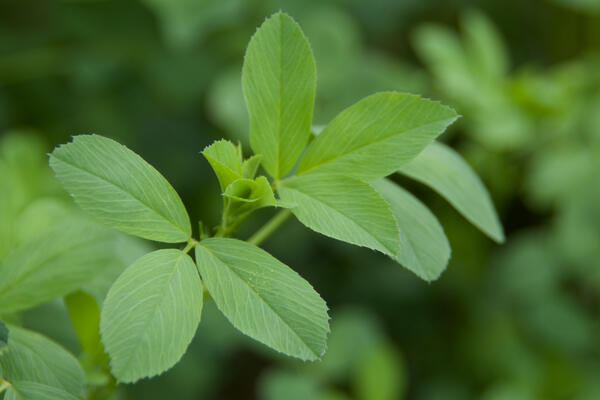
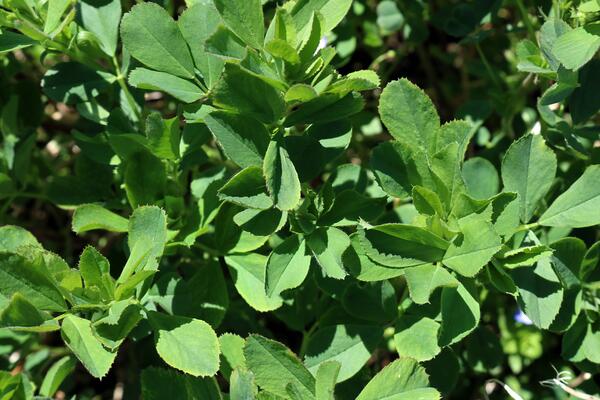
Palmately trifoliate leaves are oblong and smooth with no hairs (glabrous) with top 1/3 serrated and longer terminal petiolule. Some cultivars have more than three leaflets and are marketed as multi-leaf with claims for higher forage quality.
Stipules are large and pointed and green-veined.
Alfalfa roots are commonly 9-16 feet (3-5 m) and may extend much deeper. However, the majority of the root system and nitrogen fixing nodules are in the upper 18 inches (46 cm).
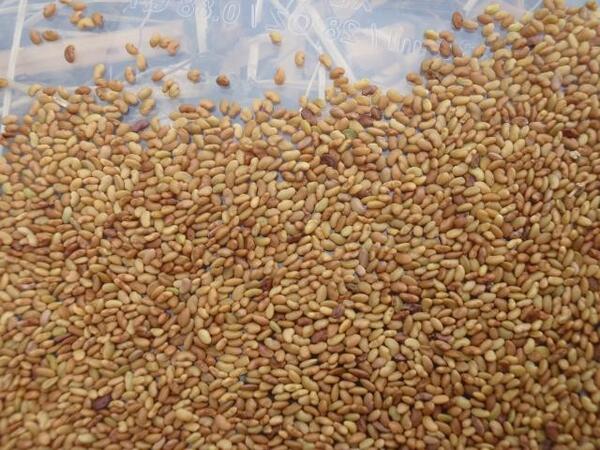
Seed pods are spiraled in 2 to 3 turns containing 10–20 seeds. Seeds are kidney shaped, yellow to greenish-yellow, browning with age. Alfalfa seeds are darker than those of yellow sweetclover.
Growth Habit and Stand Life
Growth habit is upright from a crown with 5-25 stems. Regrowth initiates from crown buds or axillary stem buds. Periodic defoliation (28-35 day schedule) is required to restore root carbohydrates for long stand life. Longevity is typically 3-6 years, depending on the cropping system.
Climate and Soil Suitability Zones
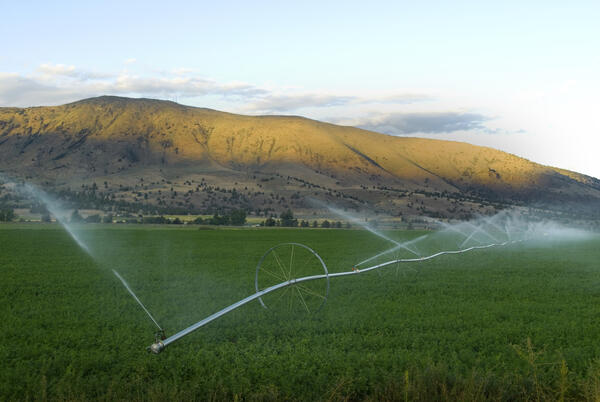
Tolerant of drought, heat, and cold. Specific heat and cold tolerances depend on FD and WSI group. [USDA Plant Hardiness zone 3 for most cold-tolerant types; Jan mean minimum of -40 °F (-40 °C); American Horticultural Society Heat Zones 1-9 <150 days above 86 ˚F (30 ˚C)]. Requires 25-40 inches (635-1000 mm) of precipitation or irrigation.
Intolerant of wet or waterlogged soils; soil drainage categories excessively drained to moderately well drained. Tolerates slightly acid to moderately alkaline soils (pH 6.1-8.4). Moderately sensitive of saline conditions (1.5-3 dS/m). Intolerant of water-soluble aluminum (persistence reduced at 0.5 ppm Al3+).
Suitability Maps
Defining the regions within the USA where the various fall dormancy (FD) and winter survival index (WSI) alfalfa cultivar types can be successfully used is an important marketing and management application of GIS technologies. These maps provide a guide for cultivar selection decisions and for identifying areas for conducting further field evaluations to validate and/or revise these maps.
Low winter temperatures limit the northern range of the FD and WSI types, while other climate and soil factors also combine to define optimal cultivar characteristics.
Agronomic field trials have been the standard evaluation technique for selecting cultivars, but extrapolation of information from one site to another for these types of trials has always been problematic. By developing suitability zone maps, based on our best knowledge of cultivar characteristics, field-based evaluation can make more efficient use of available testing resources. Using these techniques and technologies, the limited number of field trials can be extended across the USA and contribute to the global suitability information contained in the quantitative tolerances tables and function.
Drop-down menu for Fall Dormancy Level
Drop-down menu for Winter Survival Index
Climate
Jan Tmin
Jul Tmax
Ann Precipitation
Combined
Soil
pH
Drainage
Salinity
Combined
Climate and Soil Combined
Yield Potential and Production Profile
Annual alfalfa forage yield typically ranges from 4 to 10 tons/acre (9,884-24,711 kilograms/hectare). Alfalfa is more tolerant of higher temperatures than other cool-season species. Shoot growth begins at approximately 50 F (10 C), is optimal at 70-75 F (21-24 C), and declines rapidly above 90 F (32 C). Depending on temperature and photoperiod, 3-7 harvests are possible, with typically 22-25 days between harvests.
https://www.nrcs.usda.gov/Internet/FSE_DOCUMENTS/nrcs142p2_018586.pdf
Phenological Development and Bloom/Flowering Time
Phenology is the study of the timing of recurring biological events, the causes of their timing, and the interrelation among phases of the same or different species. In forage management, the importance of phenological development is the timing of management activities to optimize yield and quality. Primary among these is the relationship between yield and quality, since yield increases with time while quality declines as development advances.
Another important application is bloom time related to pollinator needs for pollen and nectar.
Important development stages of alfalfa production include vegetative, early-, mid-, and late-bud, and early-, mid-, and full-bloom. Prediction of these stages is based on temperature (growing degree days; GDD) and photoperiod.
Cultivars
Five general types of plant-breeding procedures have been used to develop alfalfa cultivars. These include plant introductions, improved populations, synthetics, hybrids, and strain crosses. Many cultivars have been developed to increase multiple pest resistance, which uses the practice of strain crossing so plant breeders can quickly incorporate multiple resistance traits. There are now hundreds of alfalfa cultivars with 11 fall dormancy (FD), 6 winter survival index (WSI) types, and insect and disease resistance (https://www.alfalfa.org/pdf/2022_Alfalfa_Variety_Leaflet.pdf). This allows for use in cold, temperate regions to subtropical zones.
Establishment and Management
All alfalfa seed should be inoculated with a fresh commercial inoculum immediately prior to seeding, regardless of cropping history of the land or any previous inoculation of the seed. Inoculated seed should be kept cool and moist until planted. Drill seeds approximately ¼ inch (0.6 cm) deep. Seedling emergence is greatly reduced when seeds are planted deeper than ½ inch (1.3 cm). For pure stands, a seeding rate of 12-15 lb/a (26.5-33 kg/ha) planted in 6-inch rows is usually sufficient for a good stand of alfalfa. However, higher seeding rates are sometimes used to compensate for poor soil preparation or seeding methods. Ensure good seed-to-soil contact with a cultipacker or roller.
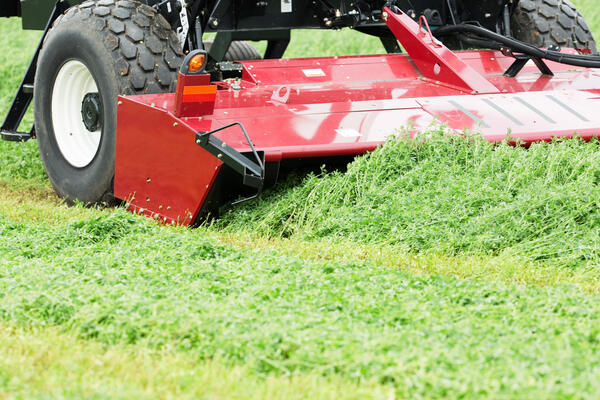
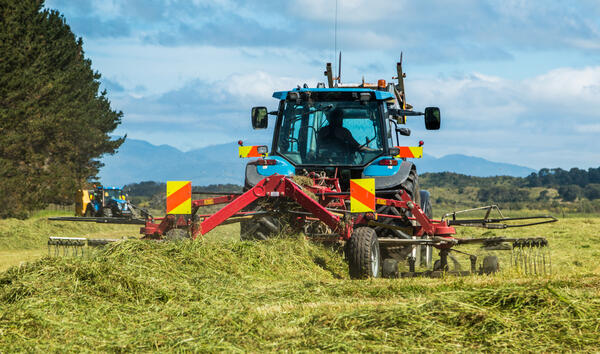
Harvesting: Harvest for hay at late bud stage for best quality and yield. For first cutting, the bloom is often delayed by cool weather and low light intensity. The appearance of new bud growth at the crown (near the soil surface) or the yellowing of lower leaves is usually a better indicator of time to make the first cutting.
Grazing: Early season grazing of alfalfa provides a method of using the first cutting, which is often damaged by spring rains if made into hay. When pastures are grazed, however, the soil must be dry enough to avoid crown damage from trampling. If alfalfa is used for year-round pasture, a rotational grazing system must be provided to allow root reserves to be replenished. A rotation that provides 28 to 35 days of regrowth is adequate. If continuously grazed, plants should be kept between 3 and 6 inches (8-15 cm) high during the spring and summer and allowed to increase to a height of 8 to 12 inches (20-30 cm) during the fall. This top growth may be removed following a killing frost without reducing winter survival.
Quality and Antiquality Factors
Alfalfa has the highest feeding value of all commonly grown hay crops when harvested at late bud or early flower stage of maturity, while also being one of the most palatable and nutritious. Alfalfa produces the greatest amount of protein per acre of any livestock feed, and is often used in combination with corn silage in livestock rations to take advantage of the protein and energy content of the two feeds. When cut prior to bloom, it is low in fiber and high in energy. Thus, it is prized as a primary component in dairy cattle rations and is an important feed for horses, beef cattle, sheep, and milking goats.
Bloat often is a problem for animals pastured on alfalfa and various clovers. Bloat is a distention of the rumen caused by an inability of the animal to eructate gases produced in the normal process of fermentation. Unfortunately, the methods of controlling bloat are troublesome, expensive, and only partially effective. Using a grass-legume mixture in pastures, supplementing legumes with grass hays, intensive strip grazing with electric fences, and drylot feeding have all been somewhat successful.
The most effective treatment involves using bloat-preventative materials. These anti-foaming compounds may be added to drinking water, applied as a top-dressing on grain supplements, included in pellets, or added to salt-molasses blocks supplied on pasture. However, the effectiveness of these methods is variable and depends upon animals obtaining a regular supply of bloat preventative.
Image Gallery



Resources
Experts
- Kenai Peninsula District Agriculture & Horticulture Agent
- Director and Professor
- Professor and Extension Alfalfa and Forage Specialist
- Professor and Extension Forage Specialist
- Extension Forage Specialist